Building a Creative Practice You Don't Need to Recover From
After 20 years of repeatitive creative burnouts, I finally learned what sustainable practice actually looks like
Do you have to earn the right to play?
LI have a long history of repeatedly burning out on creative projects or juggling a job and a creative practice. I didn’t know sustainable creative practice was even possible. And by sustainable, I mean one that is integrated with a life, not one that competes with it. One that is aimed at long distance, not a crash and burn race to complete a project and find relief.
I grew up in a culture praising all forms of martyrdom (Poland is my homeland, but I will talk about it more in the future), workaholism in those days was still perceived as noble. As a consequence, I believed for most of my life that if you want to make art, be innovative, push the boundaries, your life has to be a trial of pain that eventually might destroy you.
The Pattern I Repeated for 20 Years
Since my early 20s I repeatedly orchestrated for myself ordeals that would lead to spectacular burnouts. By burnout, I mean a state where, on the project delivery, you’re not just tired, you feel empty, and the only emotion you experience is relief. The battle is over, but the cost of enthusiasm to do or experience anything else, and surely, feeling like you never want to do it again.
Each time the script was strangely similar:
A powerful spark of inspiration and infinite excitement for a new, challenging project that felt like a divine call
Throw myself into it completely to the point that the entire World would disappear
Work obsessively—nights, weekends, every spare hour
Produce something meaningful
Collapse completely
Take months to recover
Start over and repeat with a new project
I consider myself self-taught when it comes to creativity. I never lacked intrinsic ambition or motivation, and I never lacked discipline or ideas.
But I never questioned why I was turning every project into an ordeal—or whether there was another way.
The Three Lies I Believed (Because Nobody Told Me Otherwise)
Lie 1: Real artists are about one thing only, properly obsessed
I thought that you could do one thing only—that you have to commit to your art with 100% of your time and energy. That you have to give up on everything else. One way high-speed highway only.
I thought that all-nighters spent painting, the months locked up in a garage building musical instruments, or months given to stop-motion animation were all proofs of my commitment, something noble.
What nobody told me:
If you choose to squeeze more hours than there are in the day, you’re borrowing from tomorrow, and you’ll be taxed on that. It may seem on the surface that more hours spent working equals more work done, but likely maintaining the same quality of output is not possible. You’re not a machine, you need to know and respect your limits if you really want to do this thing again and again.
Lie 2: You have to choose between commercial work and personal work, or between making art and living a fulfilling life
For years I lived a double life: commercial work during the day (3D renders, storyboards, illustrations), personal art projects at night (painting, music, building instruments, early films).
Later, trying to escape that split, I pushed for immediate results in my personal work—which always took months to materialize. My creativity started competing with living—limiting time with friends, giving up holidays. But I told myself I’d make up for it once ‘I made it.’
I thought these aspects of my life were not compatible and couldn’t coexist, that they would always be competing with each other.
What nobody told me:
You can create a lifestyle that respects all your needs. You have to make your choices, set priorities but there’s no need for sacrifice, torment and pain. The key is to live life at its pace.
Counterintuitively, the more time you spend doing one and the same thing the less creative you will be. You’ll become more efficient, more “professional” but creativity needs novelty, experimentation and play. And most importantly rest—that’s when the magic happens, when you mind connects the dots.
Lie #3: If you’re not struggling, you’re not a real artist
Romanticising the starving artist archetype is hard to evade. Many still believe that meaningful work can be only born from pain and struggle. But how many times can you imagine yourself going through such a cycle?
What nobody told me:
Suffering doesn’t make better art. All it is is a feedback mechanism screaming at you that you’re doing it wrong. Why choosing to create from the place of frustration?
You see yourself as someone with imagination, yet you’re blindly accepting a predetermined model of suffering instead of creating an alternative vision.
What I Learned the Hard Way
Lesson 1: Your body will force you to stop if you don’t do it first
Poland (Poznan), 2006: A student of architecture during the day, a painter at night. I went like this for 3 years until the physical and mental drain made me lose all love towards painting—what once was the best thing I could imagine spending my time on, became synonymous with the dreadful feeling of persistent sleep deprivation.
Italy (Milan), 2011: I worked my first architecture job 10+ hours a day, while working on designing DSDV3bass at nights and weekends. The job was demanding and so was the musical instrument design. I wasn’t going to give my dreams away. Day by day I would come more and more tired to the office causing friction with my boss, the stress was through the roof. I felt like a zombie. I gave up on architecture after 1,5 year.
Poland (Poznan), 2013: I committed with all fury to DSDV3bass. After 9 months of working 12-14h a day I felt accomplished and also done with making musical instruments.
London, 2018: After completing The Sound Of All Sounds, released after 1.5 years of struggles with editing, I moved to London. I brought my triumphant piece of work and sciatica and chronic back pain along.
My body was refusing to carry on like this when I was trying to push through it with my willpower. I’d spent all these years treating creative work like warfare—something to be conquered through sheer force at any cost.
Each time, I told myself this project was different. This time the intensity was justified. But the pattern was identical.
I had to go through these cycles so many times, losing love for things I’d cared about deeply, before I could see the self-destructive pattern for what it was.
Lesson 2: You need models of sustainable practice (and you may be better off looking outside of your field)
After moving to London I promised myself to focus on one thing—build myself as a freelance filmmaker. I started researching the business side of things for the first time, and topics like productivity, efficiency, optimization, and consistency came first into my awareness.
Reframing my identity from an artist to a creative business owner has helped me open up to insights from non-artists and find valuable insight and advice from business people.
I read a book called “The Compound Effect” by Darren Hardy that pointed out to small daily gains instead of major breakthroughs (those happen AFTER the small gains compound).
This reframing—from tortured artist to creative business owner—opened me to insights I’d previously dismissed as “soulless” or “salesy”.
I started seeing that running a business and maintaining a creative practice weren’t different pursuits. Both required:
Showing up consistently
Playing the long game (which required a clear vision and goals)
Measuring progress in small increments — the things you choose to do will compound over time to your desired result but at the same time, things you choose NOT to do will compound against you
Building systems that support your creativity, replacing the need for heroic efforts
Taking radical responsibility for the life you want to live
The artists who lasted decades weren’t more talented. They’d figured out sustainability.
This made me realise that perhaps running a business is not very different from having a creative practice, and I started to see a bigger picture where all is interconnected.
Lesson 3: It’s all about your relationship with time
At this point I’m working as a freelance filmmaker. I’m also a podcasters, working on music (goal: record an album next year), and now publishing my writing.
For the first time, I decided to do things differently.
In the past, I was desperately impatient. I believed I had to prove myself to the world by presenting finished work—the completed film, the published album, the perfect article. I overlooked what creativity actually is: the process of making it.
So now I choose to enjoy myself, even if it takes longer. I’m not letting any burnout happen again, nor will I allow myself to resent another creative discipline ‘because I overdid it again’.
Three years ago I didn’t know how to write. But working daily—just 30-60 minutes a day—I developed something I’d never had before: steady, sustainable, non-violent growth that’s actually joyful to experience.
I didn’t just learn to write. I built a rock-solid habit that proved I can do exactly the same with anything else—learning music production, developing the podcast, building the business—if I take it one step at a time.
This is the compound effect in action. Not the dramatic breakthrough, but the small daily gains that actually create lasting change.
What Nobody Told Me (That I’m Telling You Now)
After two decades of the hard way, here’s what sustainable creative practice means to me at this point:
1. Hard boundaries protect the work, they don’t limit it
5pm cutoff. No work on weekends. Not just client work—ALL work. Writing is work. Podcasting is work. Music is work.
This isn’t laziness. I get optimum results while maintaining enthusiasm in the first 4-6 hours of the working day. Everything after that is diminishing returns.
The metric that matters: how I feel waking up in the morning. I want mental clarity and physical energy at their peak, not the dread of another depleted day.
2. Personal practice gets prime hours, not leftovers
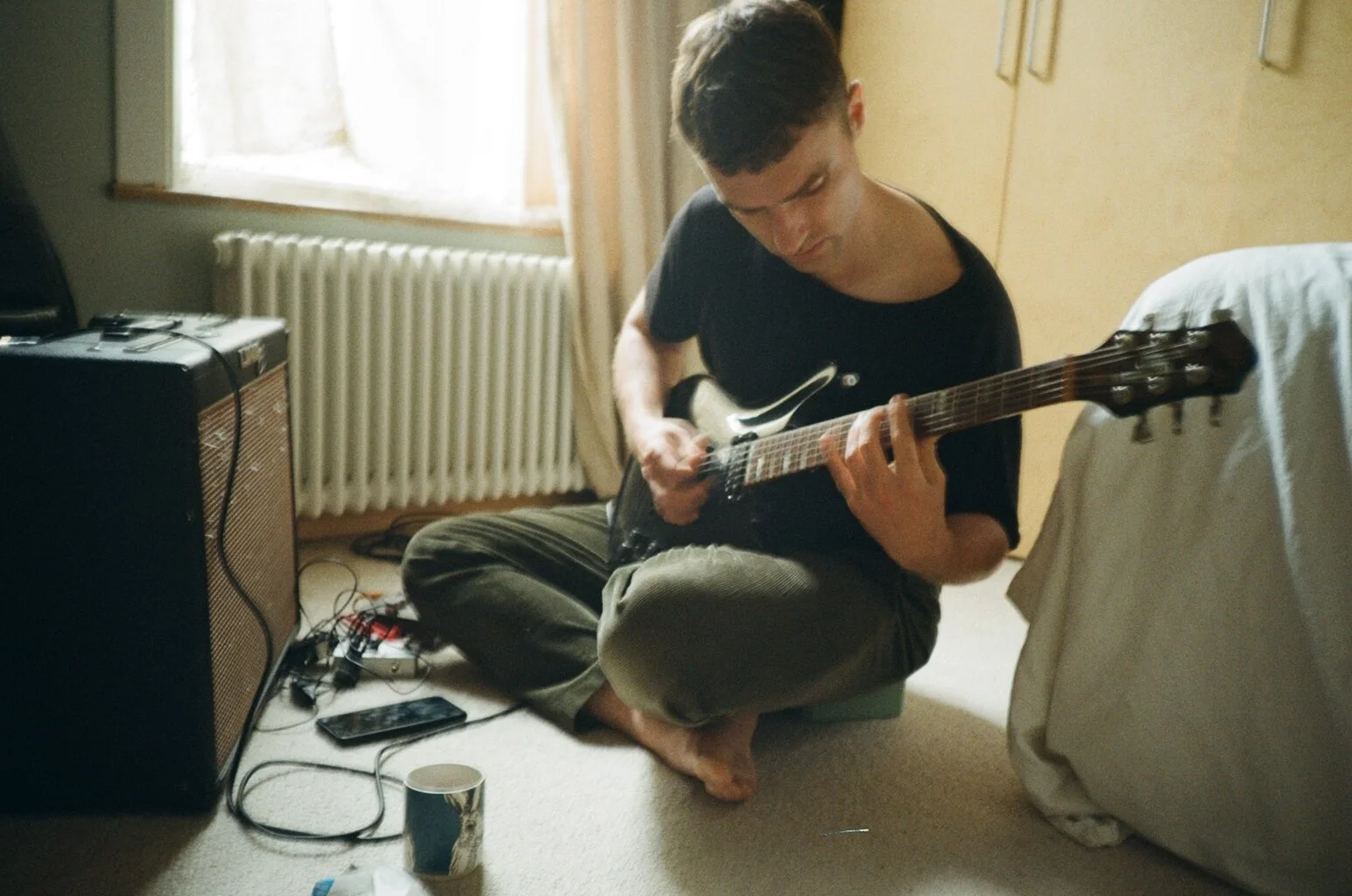
For years, I treated my creative practice as something that came after I fulfilled the duty of client work. Basically, something I need to earn the right to by hard work. Guitar sessions at 11pm. Podcast editing on weekends. Same old grinding.
I flipped the script: mornings go to the work that demands the highest creativity—currently writing and music. Client work (filmmaking) comes after, when I’m already creatively fulfilled.
Turns out when your soul is fed first, everything else flows more easily.
3. Creativity is a skill you build through practice, not a spark you wait for
The belief that you need to feel inspired to create is bullshit that plagued my life for years. Waiting for inspiration, delaying the work—that’s just resistance to the discomfort of doing something bad before it gets good. But like in sports—you start with a warm-up.
By showing up daily, you ensure the breakthroughs do happen. They won’t happen on schedule (but you’ll see them come repeatedly) but they won’t happen at all if you’re not practicing.
Practice is everything.
Why Did Nobody Tell Me This Before?
I spent 20 years dismantling a misconception about what matters.
We’re taught that the work—the painting, the song, the film—is what matters. And from a consumer perspective, it may be valid, but if you’re an artist, then these are just testimonies of the experience that truly matters: the experience of making something that otherwise wouldn’t exist.
The works enter the cultural landscape and live lives of their own. But as the creator, what you’re actually building is a practice—a sustainable relationship with creativity that can last decades, not months.
When young creatives (and I speak to myself here, in regard of music making I see myself as young) see inspiring work, the question shouldn’t be “How do I make something like this?”
It should be: “How do I create the experience of making something that makes me feel the way this does?”
Seeing life as a continuous process rather than a collection of isolated landmarks—that’s what I’m practicing now. I know what I want the process to feel like, instead of obsessing over the output.
And the process I want? One I don’t need to recover from.
I’m building that now. One day at a time.
Discipline is not a lack of freedom, it is a harmonious relationship with time — R. Rubin